 ENGLISH
 KOREAN
 Spanish
 RUSSIAN
 Armenian
 FILIPINO
 Chinese (Simplified)
 Chinese (Traditional)

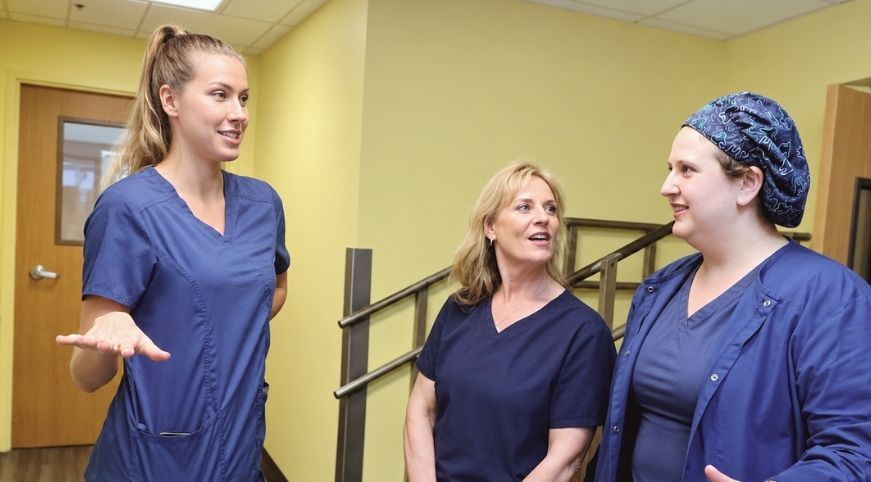
Speech-language pathologists (SLPs) play an essential role in helping patients regain communication, swallowing, cognition, and quality of life after illness or injury. From stroke recovery and traumatic brain injuries to ventilator-dependent patients, SLPs support patients through some of their most difficult moments.
In recognition of Speech-Language-Hearing Month, we spoke with three of our speech-language pathologists at CHA HPMC, Rebecca Brown, Melissa Marzigliano, and Liana Tomasevic, about their work, their patients, and the impact of speech therapy in the medical setting.
Q: Can you introduce yourselves and tell us about your roles at CHA HPMC?
Liana: I’m a speech-language pathologist here at CHA HPMC. I primarily work on the rehab unit, and I also see patients on other floors as needed. I’ve been here for a little over a year.
Melissa: I’m a speech-language pathologist. I mostly work across the street at CHALET with ventilator-dependent patients, and I also work on the acute care side. Next month will mark one year at CHA HPMC.
Rebecca: I’ve been with CHA HPMC since 2018. I work in all areas as needed, but I primarily take care of patients on the acute care side.
Q: What inspired you to become an SLP?
Liana: I knew I wanted to work in the healthcare field, and I wanted to be in a role where I could consistently work with people over time, get to know them, and help improve their communication and quality of life.
I was introduced to speech pathology in college while working at the autism center at UC Santa Barbara. A lot of the people I worked with had speech therapists, so that was my first introduction to the field. I already knew SLPs worked in schools, but when I learned they also worked in medical settings, everything aligned with what I wanted for my career.
Melissa: I really like the variety of work that we can do as speech pathologists. We can work in schools, outpatient clinics, private practice, hospitals at all levels, rehab, subacute, long-term care, and skilled nursing facilities.
I also love that we work with patients at every stage of life, from infants to older adults. But I’ve really found my passion in medical speech pathology.
Rebecca: Coming from a family deeply rooted in the medical profession—many of them nurses—I always envisioned a future for myself in healthcare. Yet I knew early on that nursing was not the path best suited to me. It was during my high school years, while volunteering at a local nursing home and assisting residents during mealtimes, that I was first introduced to the field of speech pathology. Through those experiences, I witnessed firsthand the profound impact communication and swallowing therapy could have on a person’s quality of life, and I became drawn to the uniquely compassionate and rehabilitative nature of the profession.
Q: What types of patients do you typically work with?
Rebecca: We work with patients affected by a wide range of underlying neurological conditions, including stroke, traumatic brain injuries, progressive neurological diseases, Alzheimer’s disease, and various forms of dementia. In many cases, acute medical illnesses—such as kidney or liver failure—can leave patients profoundly weakened, impairing the muscles involved in swallowing. Additionally, delirium and confusion during hospitalization may further compromise swallowing function from a cognitive standpoint, increasing the complexity of care these patients require.
Melissa: We also see trauma patients at CHALET, a long-term care facility, even though we’re not technically a trauma hospital. I work with many traumatic brain injury patients from car accidents, and we also work with very young patients.
So we really see a wide variety of people here.
Q: What are some of the most important areas SLPs work on with patients?
Melissa: We help patients learn to use speaking valves—an important step that can restore both speech and swallowing function, while also helping some individuals wean from mechanical ventilation. Few moments are as powerful as hearing a patient speak again, and watching their loved ones hear that voice too, sometimes for the first time in months. Those experiences are deeply emotional and serve as a profound reminder of the meaning and purpose behind this work.
Liana: I mostly work with stroke patients on rehab. In addition to therapy, a lot of what I do is education.
Many patients don’t realize that speech and swallowing difficulties are common after a stroke. So I spend a lot of time validating their feelings and educating them about what they’re experiencing.
Many patients are unaware that speech and swallowing difficulties are common after a stroke. For many, the experience is profoundly life-altering—one moment they are independent and healthy, and the next they are confronted with sudden disability and uncertainty. In addition to providing therapy to help patients regain their ability to swallow and communicate, I spend a significant amount of time validating their emotions and educating them about the challenges they are experiencing. Supporting patients through that emotional adjustment is just as important as the rehabilitation itself.
Q: What techniques or approaches do you use to help patients improve?
Melissa: I focus a lot on airway. Many people outside our field underestimate the relationship between the airway and the ability to talk, cough, breathe, and swallow.
Sometimes people assume a patient is swallowing fine because they’re not coughing, but if their voice isn’t functioning well, they may not even be able to cough properly to show distress.
At CHALET, I work heavily on voice therapy related to speaking valve use, while also improving swallowing strength since many patients haven’t spoken or swallowed in a very long time and become very deconditioned. We’re essentially retraining those muscles while helping patients protect their airway.
Q: Do some patients eventually regain their voice?
Melissa: Absolutely. I actually have a patient at CHALET who sings to me with his speaking valve on. He loves funk music and sings during therapy.
Singing is actually a great technique to help improve vocal quality. We want to make things functional for people, so for someone who really loves music, singing can be a great pathway for therapy.
Q: What do you enjoy most about working with your patients?
Liana: I enjoy getting to know patients and their families. Being in the hospital isn’t anyone’s favorite place to be, so it’s nice to bring humor when appropriate and build relationships with patients.
It’s also rewarding to see the progress they can make in just a few weeks and watch them communicate effectively again with family and friends.
Melissa: Especially in medical speech pathology, what patients and families go through can be very traumatizing.
If you have a stroke, yesterday you were able to talk and swallow, and today you can’t. Food and conversation are huge parts of how people connect with family and friends.
So I think it’s really important for patients and families to feel like they have someone in their corner, someone advocating for them, spending time with them, helping them with insurance calls, supporting them, educating them, and encouraging them through one of the hardest moments of their lives.
Q: Many people associate SLPs only with speech. What are some other areas you help patients with?
Liana: On the rehab side, we also do cognitive therapy in addition to speech therapy.
We work on memory strategies, problem-solving, medication management, planning schedules, managing appointments, and executive functioning skills that patients will need when they return home.
I collaborate a lot with PTs and OTs. We also work on visual scanning exercises because some stroke patients experience neglect on one side, which can affect their safety.
Sometimes we even do community outings where patients practice grocery shopping, following lists, reading, writing, remembering items, and organizing their thoughts.
Q: Are there any misconceptions about speech pathology?
Melissa: Sometimes when we recommend that patients avoid oral intake temporarily, it’s because we’re concerned that starting to eat can be medically detrimental to them.
There’s also a misconception that if a patient isn’t coughing while eating, they’re not aspirating, and that’s simply not true. Many patients can aspirate silently in the healthcare setting, and that’s a big part of our role here.
Basically, when you’re healthy, the threshold to initiate a cough is normally high. But things like encephalopathy, neurological diseases, and similar conditions can lower that threshold. So food or liquid can enter the lungs, and the body just isn’t triggering the response to cough.
That’s a big part of our role and why we conduct video swallow studies in radiology to better evaluate swallowing function. It really helps us with the diagnostic process.
One final point I’d like healthcare workers to remember is that oral care is the number one way to reduce the risk of aspiration pneumonia in the healthcare setting.
Go to our Blog


최신댓글